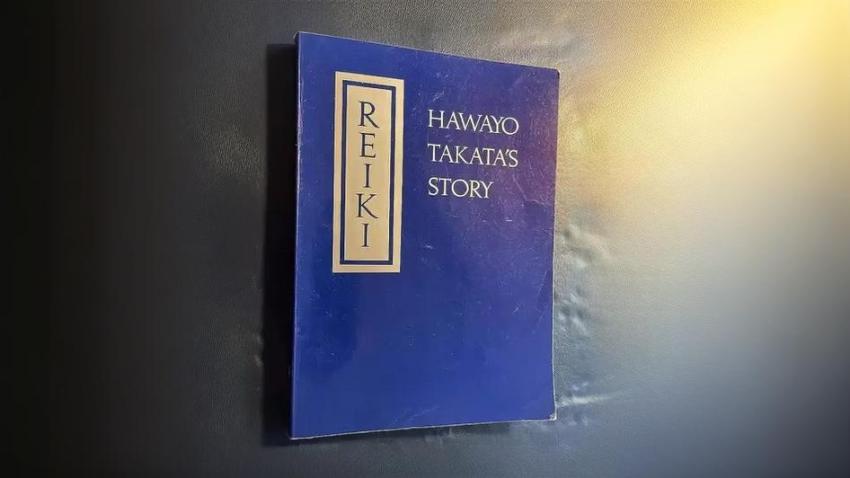
The history of Reiki as told by Hawayo Takata
Read the mythological history of Reiki as told by Hawayo Takata and compare it with the irrefutable facts discovered over the past three decades. This is the traditional story as passed down by Reiki practitioners in the West until the early 21st century (and some still do today). I say story on purpose, mythological story, because the research revealed many things differently. Compare it with other texts about history which are based on facts. Such article about the proven history of Reiki we have already published on these pages.
In this text I have added my own remarks in square brackets, as [op. B.], to see where the story diverges from fact and enters the realm of fantasy.
The myth of the Christian dean
During the Meiji era in Japan, in the mid-19th century, Dr. Mikao Usui was the dean of the small Christian university of Doshisha in Kyoto. [Note: B. Mikao Usui was born in 1865, so he could not have been the dean at that time. Research has shown that he was never actually the dean of that university.].
It was an exciting time in Japanese history, and many changes were taking place in society. The Japanese had only recently reopened their shores to "barbarian" foreigners, and they were rapidly adopting the new technology of the Industrial Revolution. Railroads were being built, and even American baseball was appearing on the scene.
Along with the return of American diplomats, Christian missionaries also returned and sparked new interest among the already eclectic Japanese (many Japanese celebrate weddings in the Shinto manner and bury with Buddhist ceremonies).
But Dr. Usui [Note: It has been proven that B. Usui was never a doctor nor did he hold an academic doctorate. This is probably a clumsy translation of the polite title Sensei. It is also possible that the title of doctor was intended to add to his importance in the West.] he sincerely accepted Christianity [Op. B. He was never a Christian but a member of the Tendai Buddhist group, as recorded on his tombstone.], he became a priest and then dean of a Christian seminary [Op. B. All of this was added by Takata to make Reiki more acceptable to the majority of Christian Americans.].
Student question
One day, during a discussion with his students, one of them asked him if he believed the Bible literally. When he answered in the affirmative, the students reminded him of the instantaneous healings performed by Christ. They mentioned that in the Bible Christ declares: “You will do as I have done, and greater works than these.” “If that is so,” they asked, “why are there not many healers in the world today who do the same works as Christ? Besides, he tells the apostles to heal the sick and raise the dead. If that is true,” the students said, “please teach us these methods.”
Usui was stunned. In traditional Japanese style, as the dean, he should have known the answer to these questions. [Op. B. All this is part of the same mythological story.]
The search in Chicago and the return to Japan
That day, Usui resigned from his position and decided to find answers to this great mystery. Since most of his teachers were American missionaries, and America was a predominantly Christian country, he decided to begin his studies at the University of Chicago Theological Seminary. [Op. B. Research has shown that he was never there. There is no record at the University of Chicago.]After a long period of study in which he received no answers, Usui decided to continue his research elsewhere.
Dr. Usui knew that the Buddha also performed incredible healings, so he decided to return to Japan and try to find some “new” old information about the types of instantaneous physical healing. Since the records of Christ’s healings had been lost, he might be able to find information about the Buddha’s healings in the Japanese Lotus Sutras. After his return, Usui began research in several Buddhist monasteries. Every time he approached the monks of various monasteries with the question, “Do you have any records of the Buddha’s healing of the body?” he would receive the same answer, namely that the focus was now on healing the spirit.
Studying in a Zen monastery
Usui persisted in his search, and after many attempts he reached a Zen monastery, where he was first encouraged to continue his search. The old monk agreed that it must be possible to heal the body, as the Buddha had done, but all the concentration for centuries had been on healing the spirit. He declared that “what was possible once can be achieved again. Perhaps you should stay here and continue your search.”
Usui felt greatly inspired by the monk's enthusiasm and began a long-term study of the sutras in Japanese. [Op. B. In fact, it was only with Hayashi, who was a physician, and then in the West, where the focus is more materialistic and less spiritual, that the emphasis began to be placed on healing the body and physical ailments. Usui considered Reiki practice primarily a spiritual discipline. This was revealed in a secret Japanese society that has continued to operate since his death to this day, although Takata claimed that Reiki died out in Japan due to the war. So this part of the story is fictional.]
Researching Sanskrit writings and preparing for fasting
When the results did not appear, he studied in Chinese and studied as many Chinese sutras as he could find. Later, after gaining some new information, he decided to study the Tibetan sutras. Knowledge of Sanskrit was required for this. And he tackled that task with pleasure. He seems to have visited North India, the Himalayas, shortly afterwards.
During the last century, Tibetan parchments have been found that corroborate accounts of the travels of Saint Isa, who many scholars believe was, in fact, Jesus. It is not known whether Usui found these parchments or perhaps other ancient parchments with records of some healings. We do know that after completing his studies of the Tibetan Lotus Sutras, he thought he had found the intellectual answers to Christ's healings. He just needed practical knowledge. [Note B. It is known that Usui traveled to foreign countries, but there is no concrete evidence for such a story. He was a researcher, a seeker, but it is not known where he was and what he researched. This is also stated on his tombstone.]
Realizing that he had found the key to healing, Usui returned to his monk friend to ask him for advice on how to acquire such knowledge. The two began to meditate, and together they came to the conclusion that Dr. Usui should head to the sacred mountain of Kurami, about 17 miles from Kyoto, and begin a twenty-one-day fast and meditation, much like the vision quests of the American Indians. [op. B. This 21-day fast really happened, and this is confirmed on his tombstone. The post took place in 1922 in the spring.].
Twenty-one days of fasting and a vision of light
Shortly thereafter, Usui began his pilgrimage to the mountain. He reached a designated spot facing east and collected a pile of 21 stones that would become his calendar.
After a twenty-day fast, the time came before dawn on the twenty-first day. Since it was the new moon, it was pitch dark when he reached for the last stone. Nothing unusual had happened up until then. He prayed for an answer. He saw a glimmer of light appear in the sky. It began to approach him very quickly. As it came closer, it grew larger. Usui began to feel afraid. He felt the urge to get up and run away. Finally, he realized that it was some kind of sign. He had searched so long and hard for all these years - he couldn't just give up. He accepted whatever might come, and in an instant the light struck him square in the forehead. Usui thought he had died.
Millions of rainbow-colored bubbles appeared before his eyes. Soon the bubbles turned white and shiny, and each contained a three-dimensional Sanskrit letter in gold. They appeared one by one, just fast enough for him to read each letter. Finally, when it was over, Usui was filled with gratitude. [op. B. On Usui's tombstone It is only mentioned that a "great reiki" appeared over him, but these details were added later for the purpose of romanticizing the story. Some versions of the story say that in the bubbles of light he saw reiki symbols.]
Four miracles when descending from the mountain
As he was in a trance-like state, when he woke up he was surprised to see that it was daylight. Excited, he wanted to share his experience with an old monk friend and started running down the mountain. He was amazed at how strong and rejuvenated he felt, considering the long fast he had just completed. This was the first “miracle” of the morning. [Op. B. The story of the four wonders is part of mythological storytelling.]
Suddenly, in his haste, he tripped and stubbed his toe on a stone. When he instinctively bent down to catch it with his hand, he was astonished to see that in a few short moments the bleeding had stopped and the toe was completely healed - the second "miracle" of the morning. [op. B. From this “miracle” arose the urban myth that Reiki miraculously heals everything. See text Urban myths.]
Continuing down the mountain, he came across a roadside tavern and ordered a full breakfast. Anyone familiar with the practices of fasting knows that it is very dangerous to break a long fast with a large meal. The owner, seeing from Usui’s monk’s robes and unkempt beard that he had been fasting and meditating, recommended a special soup. Usui refused and ordered a full breakfast. A third “miracle” occurred that morning when he ate it without difficulty. [Op. B. According to the story, Usui is showing great recklessness here. It is very likely that he did not act in this way. Reiki practice and any even remotely serious spiritual practice requires grounding and rationality as much as ecstasy and rapture.]
It so happened that the old man's granddaughter, who was serving Usui, had a severe toothache and her jaw had been swollen for days. Her grandfather was too poor to take her to the dentist in Kyoto, so when Usui offered to help her, she gladly accepted. After he placed his hands on both sides of her face, a fourth "miracle" occurred, as the pain and swelling began to disappear.
Working in a slum and bitter disappointment
Dr. Usui then continued his journey back to the monastery. He found a monk there in great pain from an attack of arthritis. As he shared his experiences with him, he laid his hands on the arthritic areas and the pain quickly disappeared. The old monk was truly amazed. Usui asked him for advice on what to do with his new ability. He was encouraged again and finally decided to go to Kyoto and work in the beggars' quarter.
He hoped to heal the beggars so that they could receive new names at the temple and thus return to society. When Usui arrived in the beggars' quarter, he immediately began his work, healing both young and old. The results were remarkable, and many were completely cured. After about seven years of such work, Usui began to notice familiar faces. [Note: B. Usui was spontaneously initiated in 1922 and died in 1926. It is impossible that he was healing somewhere for seven years.]
A young man who seemed particularly familiar to him caught his attention. “Do I know you?” he asked. “Of course!” the young man replied. “I was one of the first people you healed. I got a name, a job, and even got married. But I couldn’t handle the responsibility. It’s much easier to be a beggar.” Usui soon found many similar cases. He burst into tears of despair. Where had he gone wrong?
A lesson in responsibility
It finally dawned on him that he had forgotten to teach them responsibility, and above all, gratitude. Then he realized that healing the spirit was just as important as healing the body. He realized that by giving Reiki he had reinforced their begging habit even more. The importance of exchanging energy became clear to him. People must give back for what they receive or life would have no value.
[op. B. This story was invented on purpose to justify the overcharging of reiki and the importance of “energy exchange”, as it is popularly called in alternative circles. The exchange does not have to happen between the same two people, but can go in a circle - someone will give to another, but that other will not "give back" to this one, but will give when he can to someone else, and so in a circle.]
The Five Principles, Symbols, and the Spread of the Teaching
At that time, Dr. Usui created five principles of reiki. [op. B. This information is correct because these principles are written on his tombstone.] He left the beggars' quarter and began teaching throughout Japan. The purpose of the symbols he had experienced in his vision also became clear to him. [Op. B. It is true that Usui only realized the need for symbols later. However, Reiki symbols are not Sanskrit letters, and it is mentioned above that he saw these very letters in bubbles in a vision and read them.] He would use them to align people so that they would take responsibility for their own well-being. By strengthening their energy, he helped them take a bigger step towards own mastery.
With the old impurity removed, Usui began to train other teachers, young people who would join him on his travels. Shortly before his death, Usui commissioned one of his most devoted teachers, Dr. Chujiro Hayashi, a retired naval officer, to take responsibility for spreading the principles of Reiki. [Op. B. This is not accurate information because Usui did not appoint anyone as his successor. The society that was founded after his death had another man as its president.]
Hawayo Takata at Dr. Hayashi's clinic
Dr. Hayashi founded the first Reiki clinic in Tokyo. In 1935, Hawayo Takata, a young Japanese-American woman, appeared at Hayashi's clinic. She was very ill, suffering from several organic disorders, and had no energy due to depression caused by the death of her husband several years earlier. While visiting her parents who had returned to Japan, she was about to undergo surgery.
Then she heard the voice of her late husband urging her not to have surgery. After she expressed her doubts about the upcoming surgery to the doctor, he recommended that she try a Reiki clinic, where she began treatment and was finally cured. [Op. B. This information is accurate, and as for Hawayo Takata's experience with her late husband's voice – that is her personal story for which we do not know whether it happened that way or whether she slightly expanded the story.]
Understandably, Reiki impressed Takata and she decided to learn it. Reiki was a man's field, and for women that meant "hands off." Takata was a typical "gaijin" (foreign) woman and did not give up easily. In the end, her persistence won out and she completed the techniques. first i second degree. Later Takata returned to the US (Hawaii) and began her practice. In 1938, she was visited by Dr. Hayashi and his daughter. Shortly thereafter, Takata was initiated into the master and Dr. Hayashi returned to Japan. [op. B. This is proven correct information.]
Hayashi's departure
Dr. Hayashi was a great mystic. He sensed that a war with the United States was coming and began to prepare. Mrs. Takata sensed his concern and decided to return to Japan. Dr. Hayashi immediately warned her of the troubles to come. He already knew what the outcome of the war would be. He knew that Japan would be devastated and that many people would die. He warned Mrs. Takata of the preparations she would have to make to protect Reiki [op. B. By doing this, Takata wanted to emphasize her importance and support the claim that she was the only Reiki master in the world.].
Not wanting to be mobilized to participate in the violence of a future war, Dr. Hayashi decided to make the transition. One day, in the late 1930s [Note B. It was actually 1940.], in ceremonial attire, among friends, he consciously left his body by stopping his heart. [Op. B. He actually committed harakiri. This information is correct, and the story about the mystic and knowledge of the outcome of the war was probably invented for storytelling purposes.]
The spread of Reiki to the West
Mrs. Takata stayed a short time to help with the funeral, then returned to Hawaii, where she fortunately escaped the internment that befell many Japanese Americans during World War II. In addition, this brave little lady continued to teach Reiki in postwar America during the McCarthy era, a very narrow-minded period in American history.
In the 1970s, Ms. Takata began training other masters and by the time of her death in December 1980, there were 21 of them. [Op. B. There were actually 22 of them, but it is possible that they left out Barbara Weber Ray, who, according to the other masters, had defected.]Today, there are over 300 Reiki masters teaching throughout the world. [Op. B. The text is from 1992, from a book by Paula Horan.]
Read now article about the proven history of Reiki.
Boris Pecigoš, reiki master and teacher
- Reiki courses with Boris
- Reiki renewal and initiation
- Mentor class for reiki practitioners
- A Guide to Reiki for Reiki Practitioners (Articles + Videos)
- Energy intensive in nature
Browse all articles and videos in our Reiki libraryThere are quite a few of them, and you can browse them specifically by degree: reiki posts useful for all levels, and especially for those new to reiki, because it also contains the basic techniques of the first level, reiki posts for the second level which deal with reiki symbols and advanced energy work techniques, and a few reiki posts for the third level for reiki masters (and those thinking about mastering).
On our website there is more than 200 texts and videos on personal development. Start your research with our selection 20 key articles in which we thoroughly cover the most important topics.
What do we write about and what do we do for you?
Personal development. Energy hygiene. Guided meditations. Reiki and energy techniques. Mystical phenomena and experiences. Geomancy and natural energies. Energy photo prints. Land art.
Start with 20 key articles from our database of 200+ texts and videos.
- Energy analysis and consulting: Mapping the state of your energy field and detecting blockages and blockages. (more)
- Energy cleansing and restoration: Deep purification of aura and space. Removal of entities and astral parasites. Removal of spells, curses and black magic. Cancellation of vows, oaths, perjury, initiations and ceremonies. (more)
- Breaking toxic and addictive attachments: Energy release and cessation of energy loss. (more)
- Energy protection and stabilization: Protection against black magic, spells, astral parasites and other energy attacks. (more)
- Complete energy transformation: Four steps towards achieving energetic integrity, lasting peace and self-realization. (more)
- Energy intensive in nature: Deep work on your goals and energy vortex blockages. (more)
- Reiki courses: Systematic mastery of energy for personal and professional progress. (more)
- Quick sale of real estate: Removal of blockages and energy support for successful sales within 4 months. (more)
Contact
E-MAIL: boris.sasho@gmail.com
Follow our YouTube channel, the only platform besides the website where we publish new videos and posts: